Skip to main content Skip to Laboratory Animal Medicine navigation

ERBB receptor family in sebaceous gland homeostasis and sebum secretion

iScience published a review about the ERBB receptor family in sebaceous gland homeostasis and sebum secretion

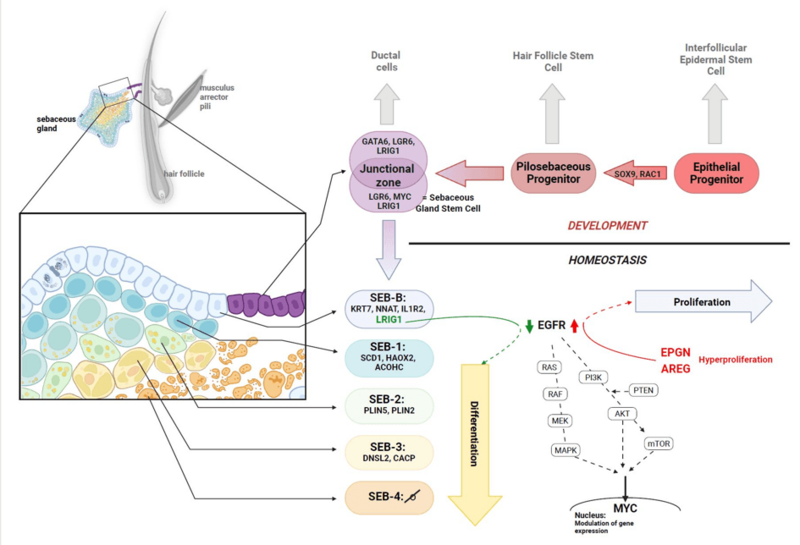
ERBB receptors are underappreciated regulators of cellular processes in the sebaceous gland (SG). They control sebocyte proliferation, differentiation, and lipid production - mechanisms that are essential for SG homeostasis, sebum secretion, and skin health. Also, impaired ERBB signaling is associated with diseases such as acne, SG hyperplasia, or skin adverse effects to some cancer therapies. By addressing current findings and unsolved aspects of ERBB signaling in the SG, this review aims to encourage deeper investigation to identify potential therapeutic strategies for common and chronic skin conditions.

Hommel T, Schneider MR, Dahlhoff M. Regulation of sebaceous gland homeostasis and sebum secretion by the ERBB receptor family. iScience. 2026 Jan 30;29(3):114834. doi: 10.1016/j.isci.2026.114834. eCollection 2026 Mar 20.


European Mouse Mutant Archive (EMMA)

Mammalian Genome published a review about EMMA.

Ensuring the quality and reproducibility of biological resources is essential for advancing biomedical research and upholding animal welfare standards. The European Mouse Mutant Archive (EMMA), part of the INFRAFRONTIER research infrastructure, plays a key role in this effort by cryopreserving scientifically validated mutant mouse and rat strains and making them accessible to the global scientific community.

To further enhance its processes and promote transparency, INFRAFRONTIER/EMMA has developed a set of ten Quality Principles specifically tailored to the unique requirements of cryopreserved rodent mutant strains.

These principles guide EMMA’s workflows by providing a structured yet flexible quality framework across its distributed nodes. They encompass both general standards—such as adherence to the 3Rs (Replace, Reduce, Refine), staff competence, and continuous improvement—and more specific areas including scientific evaluation, data curation, and intellectual property rights. Each principle is presented with contextual background, defined requirements, practical recommendations, and key references. This initiative aims to strengthen the reliability, ethical integrity, and reproducibility of preclinical research resources.

Ehlich H, Blease A, Biju R, Gustems M, Song F, Fessele S, Massimi M, Bozonelos K, Ntafis V, Hiltunen AE, Marschall S, Stoeger C, Khorshidi Z, Ziadi A, Jambou K, Armagno A, Scavizzi F, Raspa M, Fernandez J, Del Hierro MJ, Ayadi A, Pensavalle J, Prevost G, Dufková L, Krupkova M, Nickl P, Krimpenfort P, van de Ven M, Jonkers J, Valera Vázquez G, Raess M, Beckers J, Moles A, Dahlhoff M, Montoliu L, Hérault Y, Hinttala R, Kontoyiannis DL, Sedlacek R, Hrabě de Angelis M, Boersma AA, Matteoni R. A quality framework for cryopreserved rodent disease models: INFRAFRONTIER quality principles in EMMA archiving and distribution. Mamm Genome. 2025 Dec 10;37(1):10. doi: 10.1007/s00335-025-10174-4.

Guidelines for the refinement of rodent cancer models

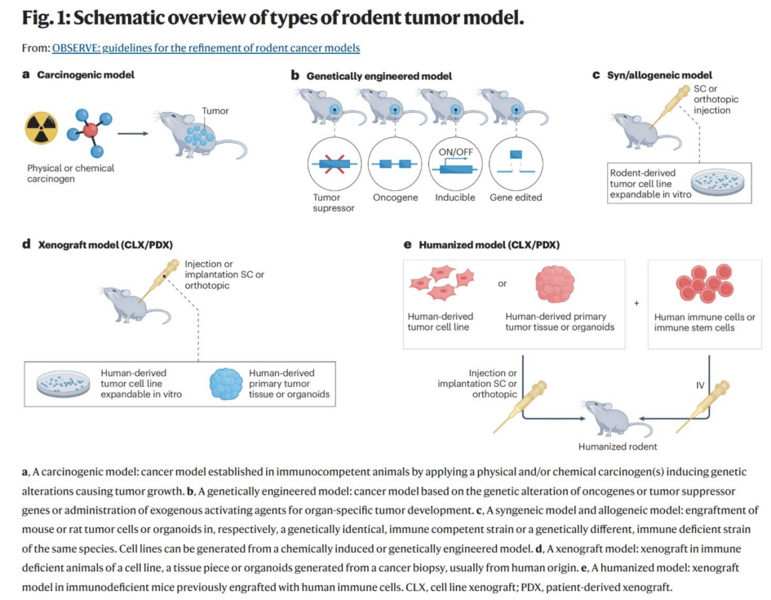
Nature Protocols published OBSERVE: guidelines for the refinement of rodent cancer models

Existing guidelines on the preparation (Planning Research and Experimental Procedures on Animals: Recommendations for Excellence (PREPARE)) and reporting (Animal Research: Reporting of In Vivo Experiments (ARRIVE)) of animal experiments do not provide a clear and standardized approach for refinement during in vivo cancer studies, resulting in the publication of generic methodological sections that poorly reflect the attempts made at accurately monitoring different pathologies.

Compliance with the 3Rs guidelines has mainly focused on reduction and replacement; however, refinement has been harder to implement. The Oncology Best-practices: Signs, Endpoints and Refinements for in Vivo Experiments (OBSERVE) guidelines are the result of a European initiative supported by EurOPDX and INFRAFRONTIER, and aim to facilitate the refinement of studies using in vivo cancer models by offering robust and practical recommendations on approaches to research scientists and animal care staff. We listed cancer-specific clinical signs as a reference point and from there developed sets of guidelines for a wide variety of rodent models, including genetically engineered models and patient derived xenografts. In this Consensus Statement, we systematically and comprehensively address refinement and monitoring approaches during the design and execution of murine cancer studies.

We elaborate on the appropriate preparation of tumor-initiating biologicals and the refinement of tumor-implantation methods. We describe the clinical signs to monitor associated with tumor growth, the appropriate follow-up of animals tailored to varying clinical signs and humane endpoints, and an overview of severity assessment in relation to clinical signs, implantation method and tumor characteristics. The guidelines provide oncology researchers clear and robust guidance for the refinement of in vivo cancer models.

De Vleeschauwer SI, van de Ven M, Oudin A, Debusschere K, Connor K, Byrne AT, Ram D, Rhebergen AM, Raeves YD, Dahlhoff M, Dangles-Marie V, Hermans ER. OBSERVE: guidelines for the refinement of rodent cancer models. Nat Protoc. 2024 Jul 11. doi: 10.1038/s41596-024-00998-w.