- Home /
- University /
- Infoservice /
- Press Releases /
- Cheetah mummies provide impetus for reintroduction
Research
Cheetah mummies provide impetus for reintroduction
An international research team led by the National Centre for Wildlife (Riyadh) and with the participation of the Research Institute of Wildlife Ecology of the University of Veterinary Medicine (FIWI) reports on the discovery of naturally mummified cheetahs in caves near Arar (northern Saudi Arabia). The study combines radiocarbon dating, imaging and palaeogenomics and proves a millennia-old presence of the species in the region. Genetic analyses provide central impulses for future reintroductions. The article was recently published in the Nature journal Communications & Earth Environment.
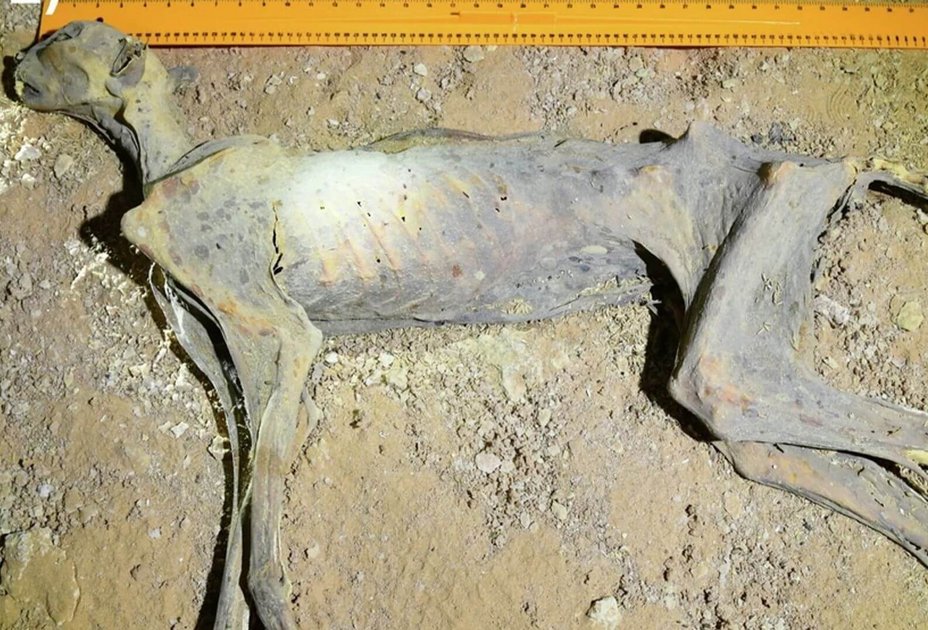
Researchers have discovered the mummified remains of cheetahs in caves near the northern Saudi city of Arar – some are more than 4000 years old. A total of seven mummies were found, as well as numerous bones that were naturally preserved. How this came about is not fully understood; presumably, dry conditions and stable temperatures in the caves ensured the exceptional preservation.
Co-author Pamela Burger (FIWI) emphasizes the dimension of the find: "Cheetahs have suffered a particularly sharp decline in populations worldwide and have disappeared from 91 percent of their historical range." The team examined 134 caves covering an area of 1.2 km2. The finds were concentrated in five caves, including one that is accessible via a 16-meter-deep sinkhole. Radiocarbon dating was used to determine the age of the remains: some finds are around 130 years old, while the oldest remains are more than 4,000 years old. X-ray analyses show many subadult animals and juveniles – an indication that the caves were used as birthing or resting places.
Genetics lead the way for rewilding*
Palaeogenetic analyses provide key clues for nature conservation. "The youngest mummy clearly belongs to the highly endangered Asian subspecies Acinonyx jubatus venaticus - today limited to Iran - while older samples are closer to the West African subspecies A. j. hecki," says Pamela Burger. This suggests that different genetic lineages existed in Arabia for a long time. In view of new protected areas, restored habitats and successful reintroductions of ungulates in Saudi Arabia, the new finds now offer concrete, genetically based reference points for future cheetah projects. Burger sums up: "We conclude that rewilding of cheetahs in Arabia can be carried out from the subspecies that are closest to the cheetahs discovered in the caves."
The global cheetah population has shrunk sharply; no animals have been sighted in Saudi Arabia for decades. Of the Asian subspecies, which used to be found there, only about fifty animals still live in the wild, in Iran. At the same time, the cave finds show that arid cave systems are valuable archives of ancient biodiversity that can provide decision-relevant data for evidence-based species conservation programmes.
* Rewilding means letting nature become "wilder" again. Habitats are renaturalised and species that have partly disappeared are reintroduced so that natural processes such as grazing, hunting and forest development regulate themselves. The aim is to create stable, species-rich ecosystems – with as little human control as possible.
The article „Mummified cave cheetahs inform rewilding actions in Saudi Arabia” by Boug, A.A., Mir, Z.R., Jbour, S. et al. was published in Commun Earth Environ..
Scientific article
Scientific contact:
Priv.-Doz. Dr.med.vet. Pamela Burger
Forschungsinstitut für Wildtierkunde und Ökologie (FIWI)
Veterinärmedizinische Universität Wien (Vetmeduni)
Pamela.Burger@vetmeduni.ac.at