- Home /
- University /
- Infoservice /
- Press Releases /
- Flexible use of a multi-purpose tool by a cow
Research
Flexible use of a multi-purpose tool by a cow
Once the punchline of a Far Side cartoon, “cow tools” have become a scientific reality: researchers observed an Austrian cow using a broom as a multi-functional implement, a rare form of tool-use previously confirmed only in chimpanzees.
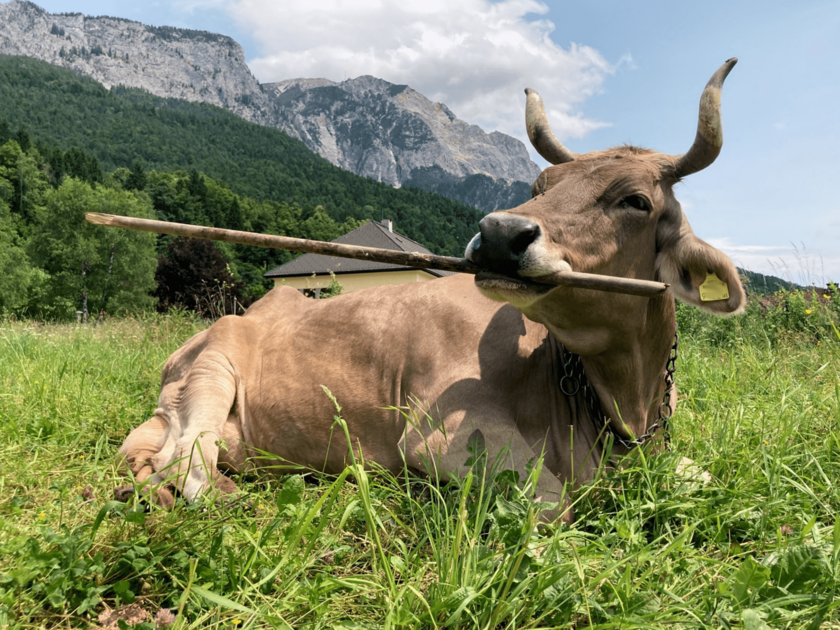
The word “cow” has made its way into human insults. Thereby it is often used to imply that someone is slow or unintelligent. This reflects a widespread assumption: livestock animals are not particularly clever. But a new study may change the way we think about cows.
Back in 1982, cartoonist Gary Larson published a Far Side comic showing a cow standing around a clumsy, dysfunctional contraption made of strange, unusable parts. The caption read: “Cow tools.” The absurdity of cows making tools was the punchline. More than forty years later, a real-life cow has delivered an unexpectedly pointed rebuttal. Her name is Veronika.
Veronika is a 13-year-old Swiss Brown cow living in the idyllic mountain village of Nötsch in southern Austria, where she grazes in a lush meadow framed by forests and peaks. She belongs to Witgar Wiegele and his family. Witgar is an organic grain farmer and the owner of a renowned artisanal bakery in town. Veronika is a charished family pet that is not raised for meat or milk.
Over ten years ago, Witgar noticed that Veronika would occasionally pick up sticks and use them to scratch herself. A friend of his filmed her behavior on a phone and sent the video to Alice Auersperg, a cognitive biologist at the Messerli Research Institute for Human-Animal Interaction shortly after the publication of her book “Erfindergeist der Tiere”. “When I saw the footage,” recalls Auersperg, “I immediately thought: this is not just a curious behavior, this is a scientifically valuable example of a measurable tool used by a species that is traditionally overlooked in relation to its cognitive abilities.” Eager to investigate further, Auersperg and her colleague Antonio Osuna-Mascaró traveled to Nötsch. “We expected to spend hours on the meadow, just waiting to see if she’d use a tool,” says Osuna-Mascaró. “But Veronika surprised us: she started using a stick the moment it was placed in front of her. She picked it up with her hand-like tongue, held it in her mouth with precision, aligned it with her body, and rubbed it along parts of her back she clearly couldn’t reach otherwise.” Following their first visit, the scientists designed an experiment to test whether Veronika’s scratching behavior met the criteria for flexible tooling. This includes using an object to extend the own body while applying mechanical force to a target.
Osuna-Mascaró then returned to Nötsch to collect the data. In a series of sessions, Veronika was presented with a deck brush (a stiff-bristled cleaning broom) placed horizontally on the ground. The orientation of the bristles, pointing left or right, was randomized each time the tool was offered. In each occasion, her choice of tool end (bristled or stick) and the targeted body region were recorded.
The findings, recently published in the renamed journal Current Biology were striking. Veronika clearly preferred the bristled end when scratching firm, broad dorsal body areas like her back. But when targeting softer, more pliable regions of her lower body, such as her udder or belly skin, she switched to the stick end. To the surprise of the researchers, Veronika also deployed distinct, task-specific, techniques. For upper-body scratching she handled the broom with broad, sweeping movements reminiscent of a human using a floor brush. In contrast, her use of the stick end on the lower body was controlled, careful and narrowly focused.
“What really caught my attention,” says Osuna-Mascaró, “was that she wasn’t just picking whichever end was closest. Instead, she adapted the tool-end and the technique depending on what area she wanted to scratch. That’s when I noticed that she seemed to be using the broom as a true multi-purpose tool.” We can talk about a multi-purpose tool use when an animal uses different features of the same object for distinct functional outcomes which is extraordinarily rare. “Until now, the only solid evidence of this has been found in chimpanzees.” adds Osuna-Mascaró. “Flexible tool use of this kind is often associated with complex cognition,” says Auersperg. “It usually requires quite a bit of motor control and some level of action planning. That a cow can do this challenges our assumptions, especially about animals we tend to view through a purely utilitarian lens.”
Veronika’s case is also remarkable because of her life circumstances. Most cows don’t reach her age, don’t live in open meadows, and aren’t provided with a variety of objects to manipulate. Her long lifespan, rich environment, and daily human contact likely created the ideal conditions for this behavior to emerge. “This is not about claiming cows are smarter than we thought,” Auersperg adds. “It’s about recognizing that our assumptions about intelligence in animals are shaped by how we treat them, and by what we bother to look for.”
The aricle “Flexible use of a multi-purpose tool by a cow.” by Antonio J. Osuna-Mascaró and Alice M.I. Auersperg was published in Current Biology.
Scientific article
Video-Abstract
Scientific contacts:
Dr. Antonio J. Osuna-Mascaró PhD
Messerli Forschungsinstitut
Veterinärmedizinische Universität Wien (Vetmeduni)
Antonio.OsunaMascaro@vetmeduni.ac.at
Assoc. Prof. Dr. Alice Auersperg
Messerli Forschungsinstitut
Veterinärmedizinische Universität Wien (Vetmeduni)
Head of Goffin Lab
alice.auersperg@vetmeduni.ac.at