- Home /
- University /
- Infoservice /
- Press Releases /
- How dogs learn by overhearing
Research
How dogs learn by overhearing
A study led by Vetmeduni and ELTE University shows that dogs with an exceptional talent for learning toy names can acquire new words by overhearing their owners’ conversations. Similar to toddlers, these “Gifted Word Learner” (GWL) dogs learn new terms both through direct address and through overheard speech. The findings were published in the journal Science.
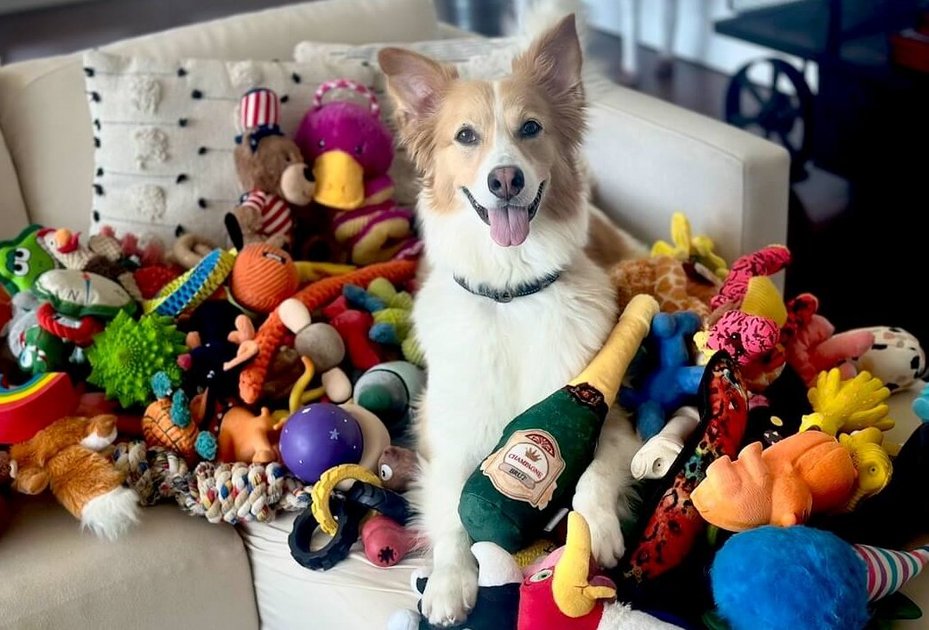
Although dogs are very good at learning commands such as “sit” or “down,” only a very small subset has demonstrated the ability to learn specific object labels. These so-called Gifted Word Learner (GWL) dogs can quickly learn hundreds of toy names during natural play interactions with their owners.
“Our results show that the socio-cognitive processes that enable learning words from overheard speech are not exclusive to humans. Under the right conditions, some dogs display behaviors that are remarkably similar to those of young children,” says lead author Shany Dror of the Clever Dog Lab at the Messerli Research Institute, Vetmeduni.
Learning by listening
In the first of two experiments, the researchers tested ten GWL dogs under two conditions. In one, two new toys were introduced and repeatedly named during direct interaction with the dog. In the other, the dogs passively overheard their owners discussing the toys with another person - without addressing the dog directly. Each toy name was presented for a total of only eight minutes, spread across several short phases. In the subsequent retrieval test - where the toys were placed in a different room and the dogs were asked by name to fetch them - seven out of ten dogs learned the new names in both conditions. In the first test trials, accuracy reached 80 percent in the directly addressed condition and 100 percent in the overhearing condition.
A key challenge mastered
In the second experiment, the toys were first shown to the dogs, then placed out of sight (in a bucket) and only afterward named. This temporal separation between seeing the object and hearing its name made the mapping more difficult. Despite this discontinuity, most dogs successfully learned the new toy names. According to the authors, this indicates that GWL dogs flexibly use different mechanisms to acquire new object labels.
The study suggests that learning from overheard speech relies on general socio-cognitive mechanisms that may be shared across species and are not tied exclusively to human language. At the same time, Gifted Word Learners are very rare; their exceptional abilities likely reflect a combination of individual predispositions and specific life experiences. Dror emphasizes that these dogs provide an exceptional model for investigating the cognitive capacities that enabled language development in humans. She also makes clear that most dogs do not learn in this way.
Der Artikel "Dogs with a large vocabulary of object labels learn new labels by overhearing like 1.5- year- old infants." by Shany Dror, Ádám Miklósi, Boglárka Morvai, Andreea-Silvia Năstase and Claudia Fugazza was published in Science.
Scientific article
Scientif contact:
Shany Dror, PhD.
Clever Dog Lab/Messerli Forschungsinstitut
Veterinärmedizinische Universität Wien (Vetmeduni)
shany.dror@vetmeduni.ac.at