- Home /
- University /
- Infoservice /
- Press Releases /
- First direct observation: Female dog kills puppies within her own pack
Research
First direct observation: Female dog kills puppies within her own pack
Researchers from Vetmeduni and the University of Hildesheim have, for the first time, directly observed a free-ranging female dog – called Fig – killing and partially consuming the puppies of a related pack member. Such behavior, known as infanticide, is documented in mammals but has mostly been reported in males, for example in lions. Among females it has long been described less frequently – partly because such incidents tend to be rare and occur quickly, making them difficult to observe. To contextualize the observed case and test two hypotheses regarding the underlying motivation, the observational study drew on social data from eight packs of free-ranging dogs.
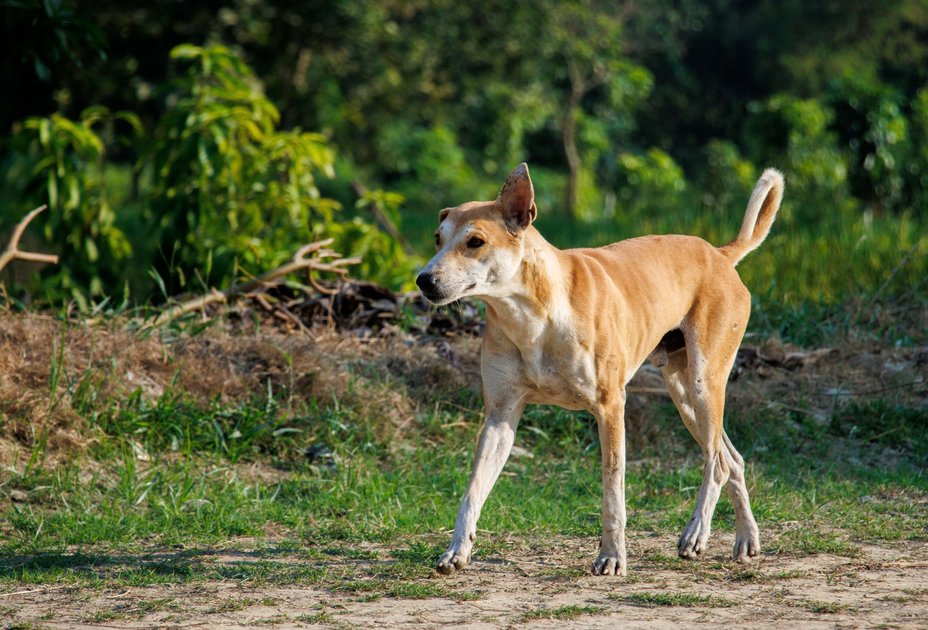
The researchers examined two common frameworks. According to the “exploitation hypothesis,” infanticide occurs primarily for nutritional reasons: young are killed in order to be eaten. The “resource competition hypothesis,” by contrast, views infanticide as a means to secure scarce resources for one’s own offspring – such as food, attention from the group, or even milk. The latter can play a role when mothers provide communal care for their young, which has previously been observed in free-ranging dogs.
No hunger: Resource competition as the likely motive
The data clearly argue against hunger as a motive. Lead author Melissa Vanderheyden of the Domestication Lab at the Konrad Lorenz Institute of Ethology (Vetmeduni) explains: “Based on our observations, we do not think the female was interested in the nutritional value of the puppies. We recorded daily body condition scores reflecting the physical status of all females. Fig had the highest scores in the group. She was not starving - if anything, she was overweight.”
Rank order decisive?
According to the authors, it is more likely that the dominance hierarchy within the pack played a role. Fig had only recently become the highest-ranking female after the former alpha female disappeared. Killing the puppies may have served to consolidate her new position. More importantly, the researchers observed that when multiple females in the same group give birth within a short time frame, dominant females tend to have their litters earlier than subordinate ones. Older puppies have advantages over younger ones – they are larger and stronger. It is therefore quite plausible that the dominant female sought to secure this head start for her own offspring. If dominant females consistently kill the puppies of subordinate females whenever the latter give birth first, it may be advantageous for subordinate females to delay parturition.
“Such a pattern is also known from other species, such as mongooses and the greater ani, a cuckoo relative. Females usually cease killing once they have their own young—either because later-born competitors are less threatening, or because they can no longer reliably distinguish others’ young from their own. Pooling multiple litters in a shared den further complicates recognition. This is exactly what often happens in species where litters arrive in quick succession. This strategy allows subordinate females to give birth shortly after the dominant female without incurring a high risk that their puppies will be killed,” explains Vanderheyden. “Although this study is based on a single observed case of infanticide, the birth-order pattern within groups suggests that competition among females over their offspring plays an important role in free-ranging dogs. That is our hypothesis, but it can only be confirmed when additional cases of infanticide are observed.”
The article “A Direct Observation of Infanticide by a Female Free-Ranging Dog (Canis familiaris) Supports the Resource Competition Hypothesis” by Melissa Vanderheyden, Brenda Chaignon, Clément Car, Małgorzata Pilot, Ikhlass el Berbri, Sarah Marshall-Pescini, Friederike Range and Andreas Berghänel was published in Ecology and Evolution.
Scientific article
Scientific contact:
Melissa Vanderheyden MSc.
Konrad-Lorenz-Institut für Vergleichende Verhaltensforschung (KLIVV)
Veterinärmedizinische Universität Wien (Vetmeduni)
melissa.vanderheyden@vetmeduni.ac.at