- Home /
- University /
- Infoservice /
- Press Releases /
- Climate change: Changes in food supply for dormice in the Vienna Woods
Research
Climate change: Changes in food supply for dormice in the Vienna Woods
A study conducted over almost 20 years by the University of Veterinary Medicine Vienna investigated the influence of climate change on beech mast production and the resulting consequences for edible dormice. According to the study, the effects are already clearly noticeable in the Vienna Woods – both for the beech trees and for the hibernating rodents. The mast years with high seed production in beech trees follow a two-year cycle, resulting in a highly variable supply of beechnuts, which are an important resource for dormice. The situation could get worse in the future, particularly if a breakdown of the beech mast seeding happens.
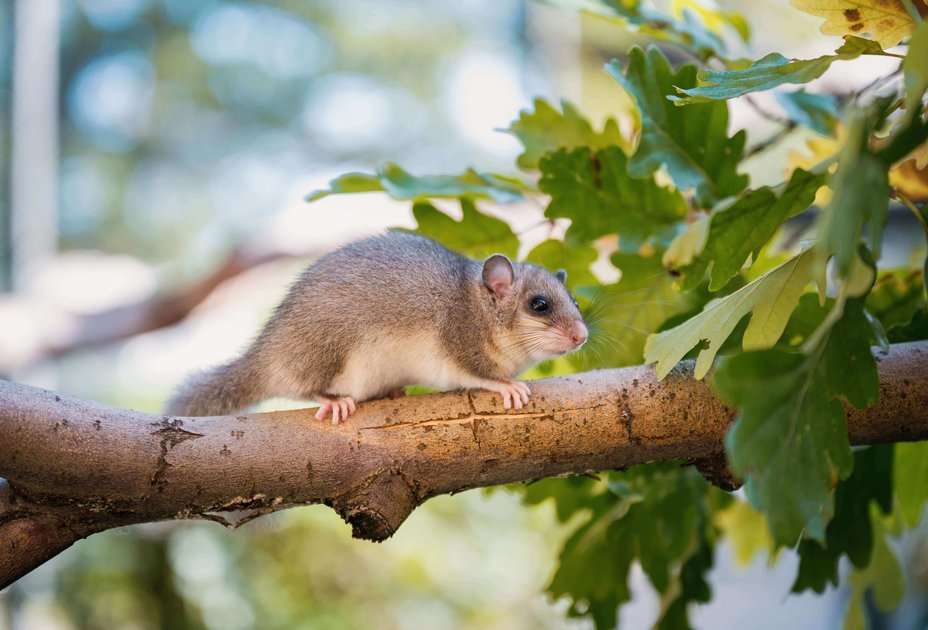
Climate change has both direct and indirect effects on species. The degree of these effects varies depending on the species and context. In particular, scientists suspect that indirect effects are more significant for consumers of pulsed resources. Against this background, a team from the Research Institute of Wildlife Ecology (FIWI) at Vetmeduni studied free-living edible dormice (Glis glis) in the Vienna Woods. Specifically, they investigated how higher average air temperatures associated with climate change affect the mast of the European beech (Fagus sylvatica) and how this change is shaping the life history of dormice. To this end, the scientists analyzed data from a total of 2,530 individuals over a period of 17 years. Air temperature data and pollen data from European beech trees – as a proxy of seed production - were also collected.
The beech in the Vienna Woods: Dramatic changes in food supply
"Our results show that the increase in average air temperature was associated with a shift in beech pollen production. In recent years, this has resulted in a two-year mast cycle (compared to an irregular cycle in the past) with a sequence of years with very high and very low seed availability," reports study first author Lukas Hochleitner from FIWI. The changed cycle of mast events significantly reduced the overall survival rate of one-year-old dormice (so-called yearlings). However, the overall survival rate of adult animals remained stable. At the same time, litter size increased significantly in both age groups (yearlings and adults). “In addition, the survival probabilities in the two age groups differed between years with a large food supply (mast years) and those with a low food supply (mast-failure years ),” Hochleitner continues.
Significant impacts on the life and survival of dormice
„The recorded changes in beech seed production demonstrate massive impacts on the animals which rely on the pulsed food resource. Our findings strongly suggest, for example, that temperature-related changes in the beech mast cycle have an effect on the trade-off between reproduction and survival in dormice”, says Hochleitner.
With its findings, this study provides first insights into the effects of global warming on the complex system of seed producers and seed consumers. However, according to the scientists, it is completely unclear what effect a possible future breakdown of the beech mast pattern in temperate forest ecosystems will have.
The article „Indirect effects of higher mean air temperature related to climate change on major life-history traits in a pulsed-resource consumer“ by Lukas Hochleitner, Shane Morris, Maximilian Bastl, Thomas Ruf and Claudia Bieber was published in „Scientific Reports“.
Scientific article
Scientific contact:
Lukas Hochleitner MSc.
Forschungsinstitut für Wildtierkunde und Ökologie (FIWI)
Veterinärmedizinische Unversität Wien (Vetmeduni)
lukas.hochleitner@vetmeduni.ac.at