Research
Grabbed by the head or by the tail: How cellular energy metabolism handles coenzyme Q
Scientists at Jagiellonian University in Kraków and the University of Veterinary Medicine Vienna (Vetmeduni) have jointly uncovered, at atomic resolution, fascinating features of bacterial cellular energy metabolism. Using cryo-electron microscopy (cryo-EM), the teams determined high-resolution structures of the cytochrome bc1 complex with native coenzyme Q (ubiquinone) bound at its catalytic sites, revealing two fundamentally different binding modes. The groundbreaking study was published in the Proceedings of the National Academy of Sciences USA (PNAS).
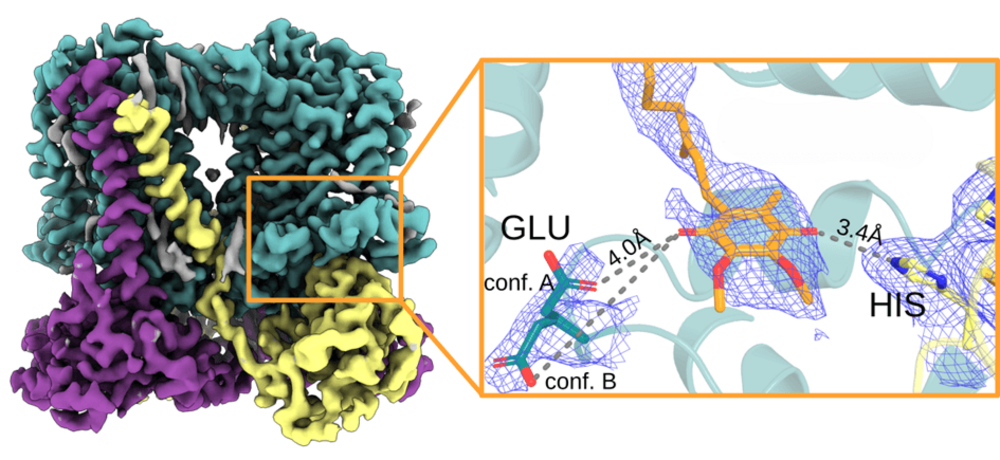
Cytochrome bc1 plays a central role in cellular respiration and photosynthesis, catalyzing energy-conserving reactions involving coenzyme Q – a molecule with a chemically reactive head group and a long hydrophobic tail that enables its mobility within the membrane. The enzyme’s two catalytic sites operate in markedly different ways: at one site, activity is switched on and off by the movement of a protein domain carrying an iron-sulfur cluster.
The new structures show that, at this dynamic site, coenzyme Q anchors its tail in a cleft that runs through the complex. Only when the site is active can the head group enter a pocket near the iron-sulfur cluster; in the inactive state, steric hindrance keeps it safely out, holding it nearby until the enzyme is ready. “This protective mechanism prevents the coenzyme Q head group from engaging in unwanted reactions that could occur if it entered the pocket while the mobile domain is in the inactive position,” explains Sebastian Glatt (Vetmeduni). “Such reactions could lead to inefficient energy storage by the complex.”
At the second site, the strategy is reversed: the head group is immediately fixed in a catalytically competent position while the tail remains mobile. Artur Osyczka (Jagiellonian University) summarizes: “Cytochrome bc1 employs two distinct strategies for binding coenzyme Q, reflecting the different architecture and functional properties of its catalytic sites. At the dynamic site, coenzyme Q is first ‘caught by the tail’ before its head group is locked in place for the chemical reaction. At the structurally stable site, it is ‘caught by the head’ while its tail remains free to move.”
This study is the third publication arising from the fruitful collaboration between the research groups led by Professor Osyczka and Professor Glatt. The structures were determined from data collected on a Titan Krios G3i cryo-electron microscope at the SOLARIS National Synchrotron Radiation Centre in Poland.
The article "Distinct ubiquinone binding at the oxidation and reduction sites of cytochrome bc1" by R. Pietras, A. Wójcik-Augustyn, B. Mielecki, M. Sarewicz, M. Jaciuk, Ł. Koziej, S. Glatt and A. Osyczka was published in Proceedings of the National Academy of Sciences USA.
Scientific contact:
Prof. Dr. Sebastian Glatt
Systemgenetik
Veterinärmedizinische Universität Wien
Sebastian.Glatt@vetmeduni.ac.at