- Home /
- University /
- Infoservice /
- Press Releases /
- Curiosity over imitation: Puppies do not (yet) overimitate
Research
Curiosity over imitation: Puppies do not (yet) overimitate
Puppies do not (yet) imitate irrelevant actions - this is the conclusion of a new study by the Messerli Research Institute at the University of Veterinary Medicine, Vienna. The study examined 54 six- to eight-week-old puppies that were still living with their breeders, mothers, and littermates - so before adoption and likely before a close dog–human bond with a primary caregiver has formed.
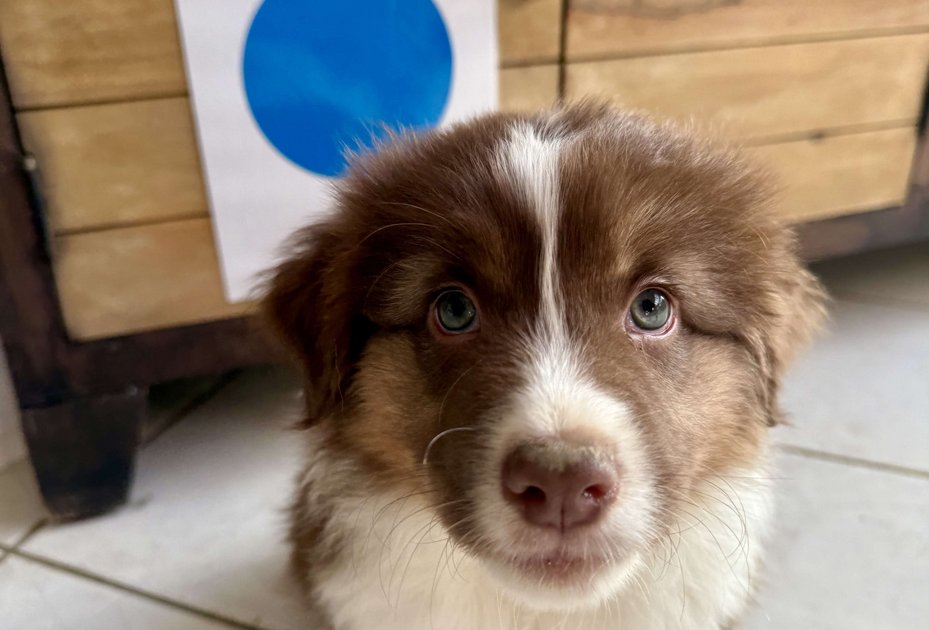
The researchers used the same established paradigm as in studies with adult dogs: Two colored dots on a wall served as the irrelevant action, while opening a treat-baited bucket was the relevant action. First, the puppies explored the room without cues. They then watched the breeder touch both dots with her nose and open the bucket before taking their own turn. “Our results suggest that early dot-touching in puppies is primarily exploratory - rather than a precise copying of the demonstrated, irrelevant actions,” says Karoline Gerwisch, first author of the study and a PhD student at the Messerli Research Institute, Vetmeduni Vienna. “More precise copying may emerge only with a stronger bond to a caregiver.”
Early curiosity rather than overimitation
In the test, some puppies also touched a dot, while others went straight for the reward. There was no significant difference in dot-touching between puppies and adult dogs. At the same time, puppies in the control condition without a demonstration did not differ from their test trials - indicating that the dots were explored out of curiosity rather than deliberately imitated. One notable detail: Unlike adult dogs after a demonstration, puppies never touched both dots; adults show greater accuracy when copying irrelevant steps. Puppies also opened the relevant bucket slightly more often than adult dogs - likely because they have not yet been trained to hold back around food. Regardless of the demonstrated technique, both puppies and adult dogs almost always used their noses rather than their paws to open the bucket - consistent with previous findings and suggesting that, for the relevant task, the outcome is copied rather than the exact movement.
Bonding as the key
The study supports the idea that so-called overimitation - the precise copying of even irrelevant actions - is linked to the quality of the relationship with the demonstrator and may increase as that bond develops. Adult dogs demonstrably copy the irrelevant steps of their caregiver more precisely than those of a stranger; young puppies do not yet show this precise copying. “We see an important ontogenetic component here: while sensitivity to humans is present early in dogs, the propensity for precise overimitation is likely strengthened through experiences of close cohabitation with humans and a deepening bond,” says Gerwisch.