- Home /
- University /
- Infoservice /
- Press Releases /
- Gerhard Breves Appointed Honorary Senator of Vetmeduni
University
Gerhard Breves Appointed Honorary Senator of Vetmeduni
At the Academic Ceremony held on 16 October 2026, the Senate of the University of Veterinary Medicine Vienna (Vetmeduni) conferred the title of Honorary Senator upon Professor Gerhard Breves. With this distinction, Vetmeduni recognises Professor Breves’ outstanding international scientific reputation and his many years of formative commitment to the University’s strategic development.
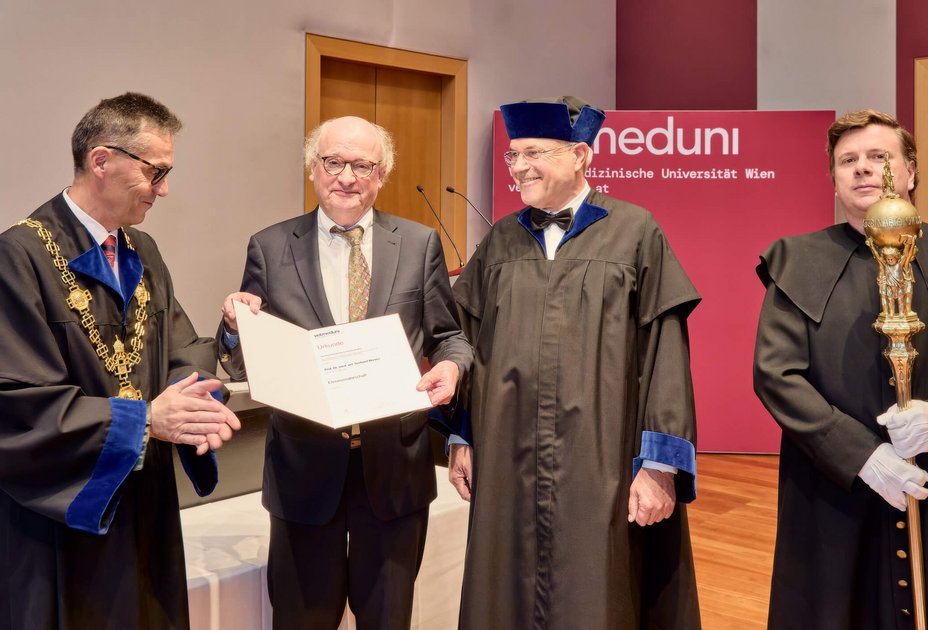
The title of Honorary Senator is among the University’s highest distinctions. It is awarded by the Senate, Vetmeduni’s highest collegial governing body, only to individuals who have rendered exceptional services to the University and to the advancement of its academic mission. By conferring this honour on Gerhard Breves, the University recognises a distinguished figure who has supported Vetmeduni as a trusted partner for many years and has made a significant contribution to advancing research at the University.
In his laudatory address, Walter Arnold, Professor Emeritus at the Research Institute of Wildlife Ecology, highlighted, among other things, Gerhard Breves’ exceptional personal commitment to Vetmeduni. His feedback and critical observations had always been consistent, respectful and constructive, accompanied by specific ideas and proposals for the University’s continued development.
Long-standing impetus for Vetmeduni
Gerhard Breves has maintained close ties with Vetmeduni for many years. From 2002 to 2022, he served as a member of the Scientific Advisory Board, chairing the body from 2011 to 2022. In this capacity, he made a major contribution to Vetmeduni’s strategic development through independent, constructive and forward-looking advice. His guidance provided orientation during key phases of development, strengthened quality assurance and internationalisation, and supported the University’s long-term profile-building efforts. His personal integrity, collegiality and willingness to contribute his knowledge and experience for the benefit of Vetmeduni have reinforced confidence in the University’s academic development.
Research with international impact
Professor Breves is internationally recognised for his fundamental contributions to physiology. His research has explored the mechanisms and regulation of gastrointestinal electrolyte and nutrient transport. He has also shaped comparative research on microbial metabolism in the rumen of ruminants and in the large intestine of monogastric animal species. In doing so, he has linked fundamental physiological questions with topics of major relevance to animal nutrition and animal health.
His academic career began at the University of Veterinary Medicine Hannover, where he studied veterinary medicine and completed his state examination. At its Institute of Physiology, he earned his doctorate in veterinary medicine in 1977 and completed his habilitation in physiology and nutritional physiology in 1986—foundations that significantly shaped his later broad and precise research profile. Following positions as a research associate and postdoctoral researcher at the University of Veterinary Medicine Hannover and at the Institute of Animal Nutrition of the Federal Research Centre in Braunschweig, Breves was appointed Professor of Veterinary Physiology at Justus Liebig University Giessen in 1990. From 1993 onwards, he headed the Institute of Veterinary Physiology there. From April 1997 until March 2020, he served as University Professor and Director of the Institute of Physiology and Cell Biology at the University of Veterinary Medicine Hannover. He has been retired since April 2020.
Beyond his own research and teaching, Gerhard Breves has made a lasting contribution to the scientific community. For many years, he served on the editorial boards of renowned specialist journals, including Archives of Animal Nutrition and the Journal of Animal Physiology and Animal Nutrition. He also acted as Section Editor for “Physiology and Pharmacology” at Animal Health Research Reviews and contributed to several expert committees of the German Research Foundation (DFG). As co-editor of the textbooks Physiologie der Haustiere and Veterinary Physiology, he also helped make physiological knowledge accessible to students and professional colleagues.
His scientific achievements have been recognised with numerous awards, including the Erich Aehnelt Memorial Prize, the Henneberg-Lehmann Foundation Award, the 2010 Biogas Innovation Award and the Martin Lerche Science Prize. Professor Breves thus represents many years of responsible work and a deep commitment to veterinary medicine—in research, teaching and scientific advisory roles.