- Home /
- University /
- Infoservice /
- Press Releases /
- Kuruka: A New Genetic Element Spreads Through Fruit Flies Worldwide
Research
Kuruka: A New Genetic Element Spreads Through Fruit Flies Worldwide
A newly discovered mobile genetic element, Kuruka, is spreading through natural populations of the fruit fly Drosophila melanogaster. A research team led by Robert Kofler at the University of Veterinary Medicine Vienna (Vetmeduni Austria) has traced when and where the element emerged. The study was published in Nature Communications.
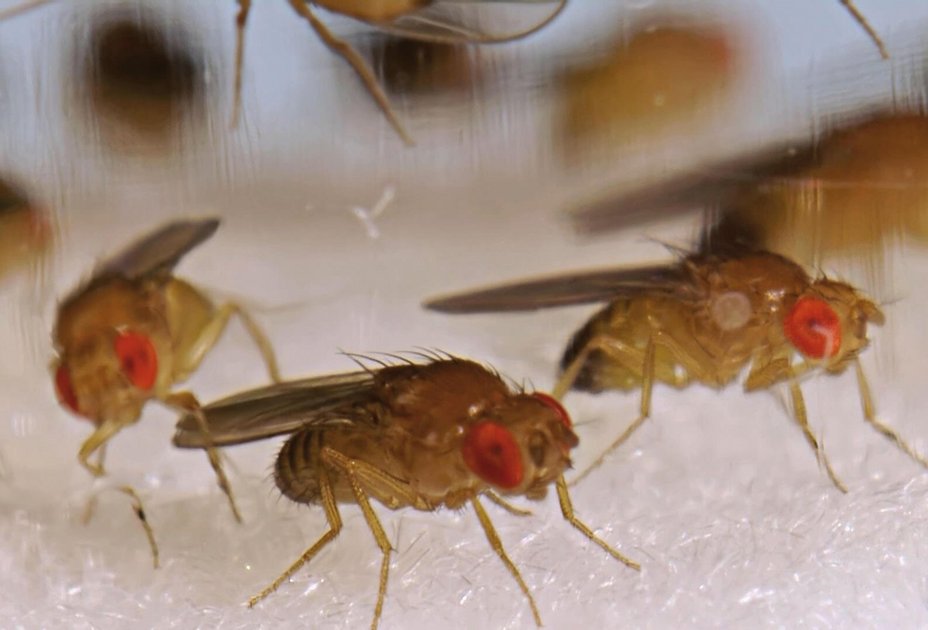
Kuruka is a so-called endogenous insect retrovirus. Such elements can replicate within the genome and insert themselves at new locations. Kuruka belongs to the Gypsy/Gypsy superfamily, is 8,833 base pairs long, and also carries a gene encoding an envelope protein. This feature is consistent with its classification as a retrovirus-like genetic element.
From Africa to the Americas, Asia and Europe
For their study, the researchers analysed 1,072 fruit fly genomes from specimens collected in different regions of the world between approximately 1815 and 2021. Their aim was to determine when Kuruka first appeared in Drosophila melanogaster and how the mobile genetic element subsequently spread. The analysis showed that Kuruka was not detectable in any samples collected before 2010, whereas it was first identified in African populations in 2010.
In the following years, Kuruka appears to have spread to other continents. From 2017 onwards, the researchers also detected its sequences in fruit flies from East Asia, the Americas, and, sporadically, Europe. In samples from the Americas and East Asia collected in 2020 and 2021, Kuruka was already consistently present. By contrast, the element could still not be detected in Australia, and it had not yet reached all populations examined in Europe. Additional samples from North America indicate that Kuruka remains present: fruit flies collected in North Dakota in 2023, and in North Dakota and Washington, D.C., in 2025, carried multiple copies of Kuruka. According to the data, its spread was still ongoing at least until 2021.
“Kuruka allows us to observe a genome invasion as it happens: we can track how the element spreads through natural populations and how the host responds to it,” explains Robert Kofler, senior author of the study and researcher at Vetmeduni’s Centre for Biological Sciences.
The researchers suspect that Kuruka spreads more slowly than certain other mobile genetic elements. One possible explanation lies in its life cycle: Kuruka is likely active primarily in somatic cells surrounding the ovaries. In order to be passed on to the next generation, the virus-like particles produced there must reach the germline. This additional step could slow its spread.
An Origin Thought to Be Extinct
The analyses suggest that Kuruka entered Drosophila melanogaster only recently through horizontal transfer—that is, it was probably transmitted from another species rather than inherited from parent to offspring. The most likely donor is considered to be the African fruit fly species Drosophila erecta. In this species, the researchers found a Kuruka sequence that matches over 8,658 base pairs with 98.85 percent similarity. Drosophila bocqueti also carries a similar, though shorter, sequence. However, the route of transmission cannot be conclusively proven; an as-yet unexamined African species or population may also have been the source.
The genome of Drosophila erecta apparently contains only a single copy of Kuruka. It is located in the flamenco region, which is involved in the defence against mobile genetic elements and can produce small RNA molecules known as piRNAs. The researchers identified numerous piRNAs targeting Kuruka, suggesting that the element is suppressed in Drosophila erecta by a protective mechanism.
“The finding shows that even an element that appears to have been declared dead in one species can become active again in a new host,” says Robert Kofler. According to the study, Kuruka is the twelfth documented invasion of a mobile genetic element in Drosophila melanogaster within the past 200 years.
The article "The ongoing invasion of the endogenous retrovirus Kuruka in natural Drosophila melanogaster populations." by Riccardo Pianezza, Sarah Saadain, Matthew Beaumont, Sarah Signor and Robert Kofler was published in Nature Communications.
Scientific article
Scientific contact:
Ass.-Prof. Dr. Robert Kofler
Zentrum für Biologische Wissenschaften
Veterinärmedizinische Universität Wien (Vetmeduni)
Robert.Kofler@vetmeduni.ac.at