- Home /
- University /
- Infoservice /
- Press Releases /
- New neighbors in urban areas: Wolves are fearful, but quickly adapt
Research
New neighbors in urban areas: Wolves are fearful, but quickly adapt
Wolves (Canis lupus) are increasingly settling in human-dominated landscapes. This growing proximity brings with it anthropogenic risks as well as opportunities. However, how this affects wolves’ fear of humans has so far remained unknown. It is precisely this question that the Konrad Lorenz Institute of Ethology (KLIVV) at the University of Veterinary Medicine Vienna, together with Italian researchers from the University of Sassari and Parma, has now sought to answer.
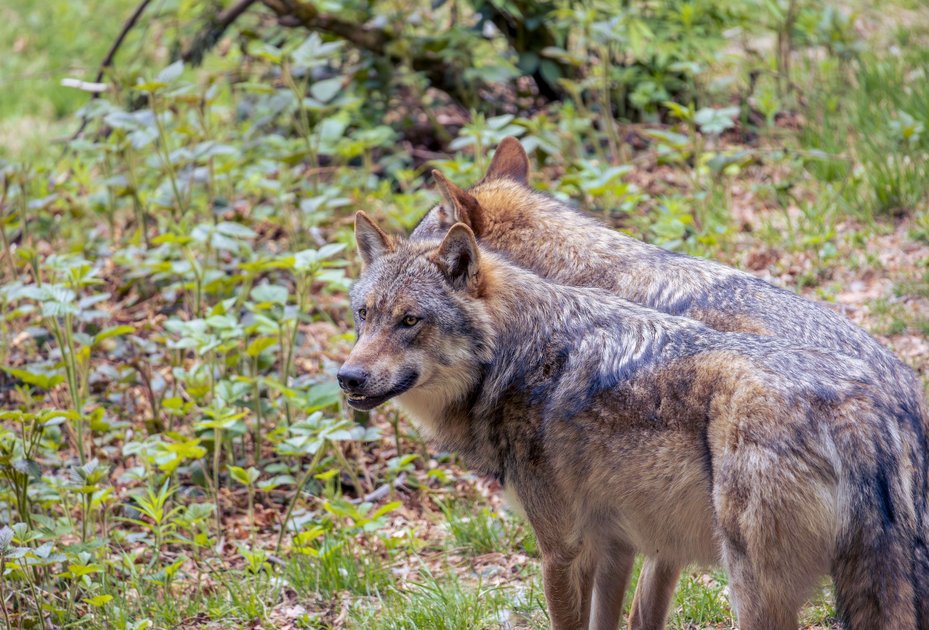
The team led by senior author Sarah Marshall-Pescini from KLIVV tested 185 individually identified, wild-living wolves at 44 sites with varying degrees of urbanization in central Italy. In the experimental setup, the animals living were confronted in their natural habitat with novel objects and with human sounds. This study represents the first experimental tests of this kind conducted on individually identified wolves in the wild. The results provide unique insights into how wolves adapt their behavior in human-shaped environments.
(Almost) everyone is afraid of humans
When first encountering a novel object, wolves from more strongly urbanized areas reacted with less fear, but with increased caution when the object changed. According to Marshall-Pescini, this suggests that reduced fear of novelty in urban areas, something which is seen in many species, is not the whole story. Rather wolves also show heightened vigilance to environmental changes, probably because more urbanized pose greater danger to wolves’ survival. In contrast, recordings of human voices triggered strong fear responses regardless of the degree of urbanization - affecting 81% of the wolves.
Regardless of their habitat of origin, however, the animals quickly and at a similar pace habituated to both stimuli, demonstrating their high learning ability. In addition, stronger social behavior reduced fear, and wolves in groups reacted less fearfully than “solitary” wolves. “The results show that wolves flexibly adjust their behavioral responses to both the risks and the opportunities in human-dominated landscapes. This is a key factor in the success of wolves in urbanized areas,” explains Marshall-Pescini.
Greater urbanization brings less caution but increased vigilance
Central Italy is one of the regions where wolves were among the earliest to settle in human-dominated landscapes, and where this process is most advanced. According to first author Martina Lazzaroni from KLIVV, the results of the newly presented experimental study highlight “the complex, context-dependent nature of fear in wolves and its variation along the urbanization gradient. The insights gained offer us a completely new perspective on the future of coexistence between wolves and humans. At the same time, they also underline the challenge of achieving peaceful coexistence.” The study was funded by the Vienna Science, Research and Technology Fund (WWTF).
The article „Wolves respond differently to human cues as they expand into urban landscapes“ by Martina Lazzaroni, Rudy Brogi, Francesca Brivio, Elena Bassi, Andrea Boromello, Tabea Teichmann, Friederike Range, Marco Apollonio and Sarah Marshall-Pescini was published in „PNAS“.
Scientific article
Scientific contact:
Priv.-Doz. Sarah Marshall-Pescini, PhD.
Konrad-Lorenz-Institut für Vergleichende Verhaltensforschung (KLIVV)
Veterinärmedizinische Universität Wien (Vetmeduni)
Sarah.Marshall@vetmeduni.ac.at