- Home /
- University /
- Infoservice /
- Press Releases /
- When tools become unbalanced: Goffin’s cockatoos flexibly adapt their technique
Research
When tools become unbalanced: Goffin’s cockatoos flexibly adapt their technique
Goffin’s cockatoos are highly skilled tool users. A recent study by the Messerli Research Institute at Vetmeduni Vienna now suggests that they also pay attention to how a tool’s weight is distributed. When handling unevenly weighted rods, the birds adjusted their grip and, in some cases, even changed their entire insertion technique in order to obtain a food reward from a box.
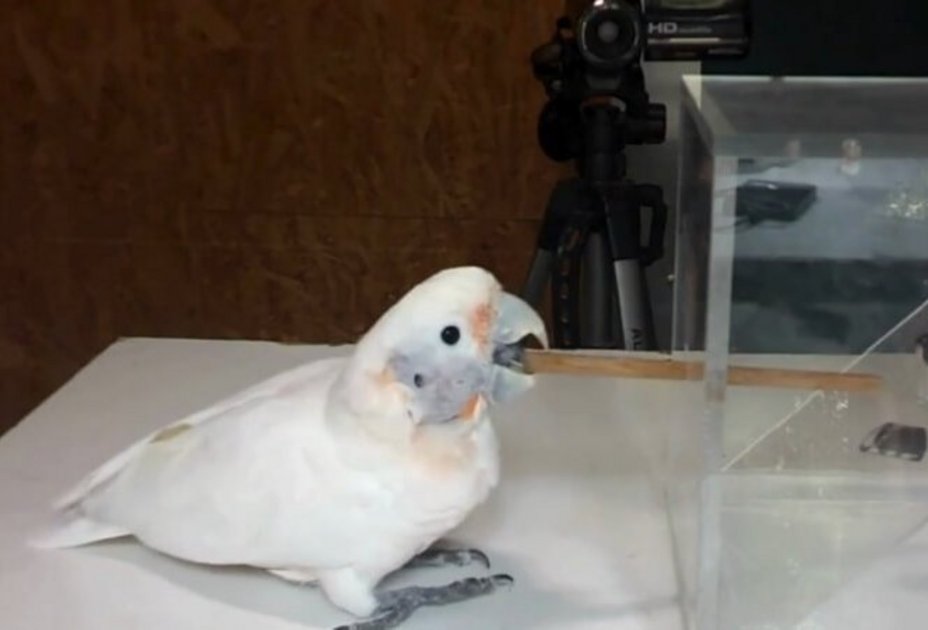
For the experiments, the cockatoos were given plastic rods measuring just under 18 centimetres in length. One end of each rod contained a 12-gram weight. The animals had to push the rod through a slot in a Plexiglas box in order to reach a nut inside. Depending on the experimental condition, the slot was positioned either horizontally or vertically. The vertical opening proved particularly challenging for the birds.
“The task became more difficult for the cockatoos as soon as they could no longer support the rod at the entrance to the box. After several attempts, some animals responded by adapting their usual technique or switching to a different one. Individual differences also became apparent: some cockatoos were more flexible than others in adapting their approach to the new conditions,” says Özge Nasa, first author of the study at the Messerli Research Institute at Vetmeduni Austria. “What matters is not only how heavy a tool is. The distribution of its weight can also determine how well it can be controlled.”
Using weight strategically
The findings suggest that the cockatoos took the distribution of weight into account. In the vertical condition, 65% of the successful runs were completed with the light side leading. This kept the heavier end closer to their grip – a position that makes it easier to control the long rod. In the horizontal condition, this proportion was 51%. The difference between the two tasks was statistically significant. Even when a bird initially picked up the rod in an unfavourable orientation, it did not necessarily persist with that choice. When the wrong end was grasped first, the animals changed the rod’s orientation in around 40 % of cases. When the initial choice was appropriate, this happened in only 19 % of trials. “This behaviour indicates that paying attention to weight distribution can be advantageous, especially when an object has functional value – as in this case, where the birds were using the tool to obtain nuts,” says Alice Auersperg, Head of the Messerli Research Institute and the Goffin Lab.
A variety of solution strategies
The results show that there is no single “cockatoo method”, the researchers conclude. Eight out of ten birds changed either their insertion technique, their handling of the weight distribution, or both when faced with the more complex task. Five animals switched techniques at least once. Some developed new solutions, while others continued using an established method as long as it remained effective. This was particularly evident in birds that had previously supported the rod at the entrance to the box. Because the new slot orientations no longer allowed this form of stabilisation, all three affected animals had to change their approach. One cockatoo subsequently used a “needling” technique involving its tongue and beak, while another used its foot for stabilisation.
The researchers see this as evidence of flexible problem-solving. Rather than relying solely on a learned movement pattern, the cockatoos appear to take both the task and the properties of the tool into account. Individual differences between the animals played an important role in this process.
The article "Handling techniques of an unbalanced stick tool in Goffin’s cockatoos (Cacatua goffiniana)." by Nasa, Ö., Folkertsma, R. and Auersperg, A. was published in Scientific reports.
Scientific contact:
Özge Nasa
Messerli Forschungsinstitut
Veterinärmedizinische Universität Wien (Vetmeduni Austria)
Oezge.Nasa@vetmeduni.ac.at
Note: This project was funded by FWF (Y-1309/PAT2728324).