- Home /
- University /
- Infoservice /
- Press Releases /
- Kaimanawa Horses: New Genome Study Reveals Their Origins
University
Kaimanawa Horses: New Genome Study Reveals Their Origins
An international genome-wide study led by the Konrad Lorenz Institute of Ethology (KLIVV) at the University of Veterinary Medicine Vienna and the University of Vienna has, for the first time, comprehensively examined the genetic composition of New Zealand’s free-ranging Kaimanawa horses. The population is descended from several horse breeds and, despite inbreeding and a small effective population size, displays moderate genetic diversity. According to the researchers, the findings provide an important basis for future conservation and wildlife management strategies.
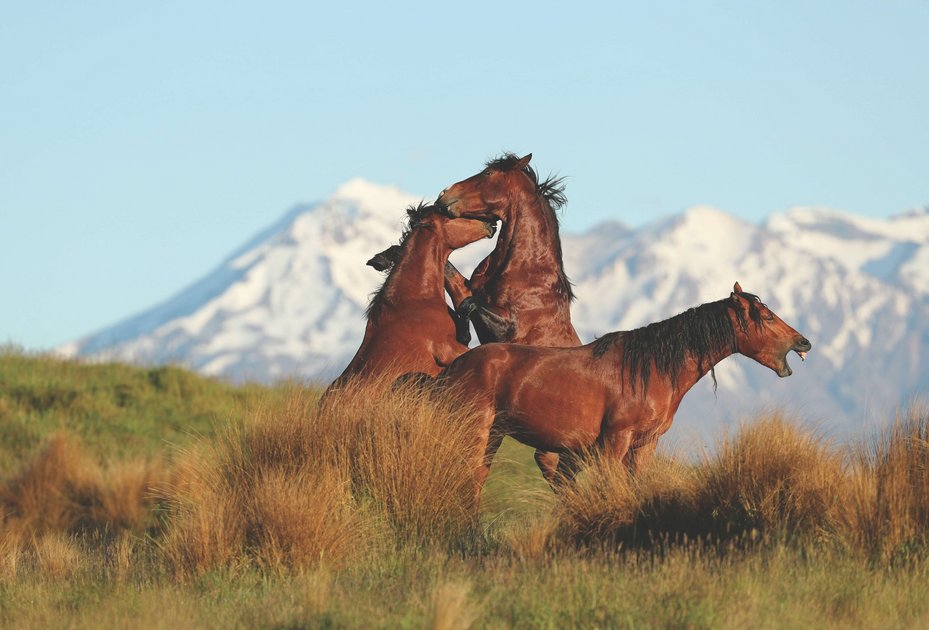
Kaimanawa horses have lived freely in the Kaimanawa Mountains on New Zealand’s North Island for several generations. Using genome-wide SNP data as well as mitochondrial and Y-chromosome data, an international research team led by Vetmeduni investigated the population’s genetic history and compared it with 22 domestic horse breeds. The findings indicate that the population originated from a mixed founder stock.
Published in BMC Genomics, the study provides the first characterisation of Kaimanawa horses based on genome-wide SNP data. It therefore represents an important resource for evolutionary and conservation genomics and demonstrates how genomic data can help align wildlife management more specifically with the preservation of genetic diversity.
A mix of breeds shaped the gene pool
The analyses revealed genetic components with affinities to British pony breeds, Thoroughbreds, Arabians and working horses, highlighting the diverse genetic background of the Kaimanawa population. “Our findings paint the picture of a population whose genetic history has been shaped by several founder lineages,” explains Dr. Elmira Mohandesan of Vetmeduni’s KLIVV, the study’s senior author.
The genetic structure of the Kaimanawa horses can be divided into two subgroups. Differences in genetic diversity and inbreeding appear to be associated with population size, geographical isolation and restricted gene flow.
Population size and landscape structure are relevant to genetic development
These differences are particularly pronounced in the Argo Valley, a valley within the Kaimanawa Mountains. There, the research team found the highest levels of inbreeding and the lowest genetic diversity. By contrast, the southern zones showed the greatest genetic diversity and the lowest level of inbreeding. The researchers note that recent population management measures may not yet be fully reflected in the genetic data. In future, removals, relocations and fertility-control measures could further influence the genetic development of individual subpopulations.
“Our study shows that population size and landscape structure play an important role in the genetic development of these horses. Previous management practices may also influence gene flow between subpopulations,” says Mohandesan.
Preserving genetic uniqueness
The analysis of the Y chromosome was of particular interest. It identified paternal haplotypes that are not found in the reference populations of modern horse breeds included in the study. According to the researchers, this suggests that Kaimanawa horses have retained unique genetic variation on their paternal line.
“It is precisely these rare genetic lineages that underline the conservation value of this population. Kaimanawa horses may therefore also be important for research into genetic adaptation and the development of other feral horse populations,” Mohandesan emphasises.
Funding: This project was funded by the Austrian Science Fund (FWF) through grant P 37088-B (DOI: 10.55776/P37088).
Scientific contact:
Elmira Mohandesan PhD.
Konrad-Lorenz-Institut für Vergleichende Verhaltensforschung (KLIVV)
Veterinärmedizinische Universität Wien (Vetmeduni)
Elmira.Mohandesan@vetmeduni.ac.at